Why this exists
I didn’t build CEOS to sell it. I built it for myself.
I’m the kind of person who always has one more idea, and I’d lie awake wondering whether this one was a real business or just a feeling. I knew the trap: not every idea deserves to be built. The wrong one costs you years and your savings to find out the hard way.
A chatbot that agrees with me wasn’t going to help. What I needed was a team of specialists, each with one job. Research the market, find who already tried it, name what would kill it, deliver an honest verdict. And when an idea was weak, send it back to be reworked, not rubber-stamp it.
But a team is only as good as its timing. I needed it to run like a Swiss watch: every part in sync, nothing out of place, the same result every time you wind it. So I gave it a Watchmaker: one role whose only job is to keep the whole team in time.
That precision is the whole point. It’s where the name comes from: The Swiss Man.
The first time I put it on paper, explaining it to a friend, it looked like this:
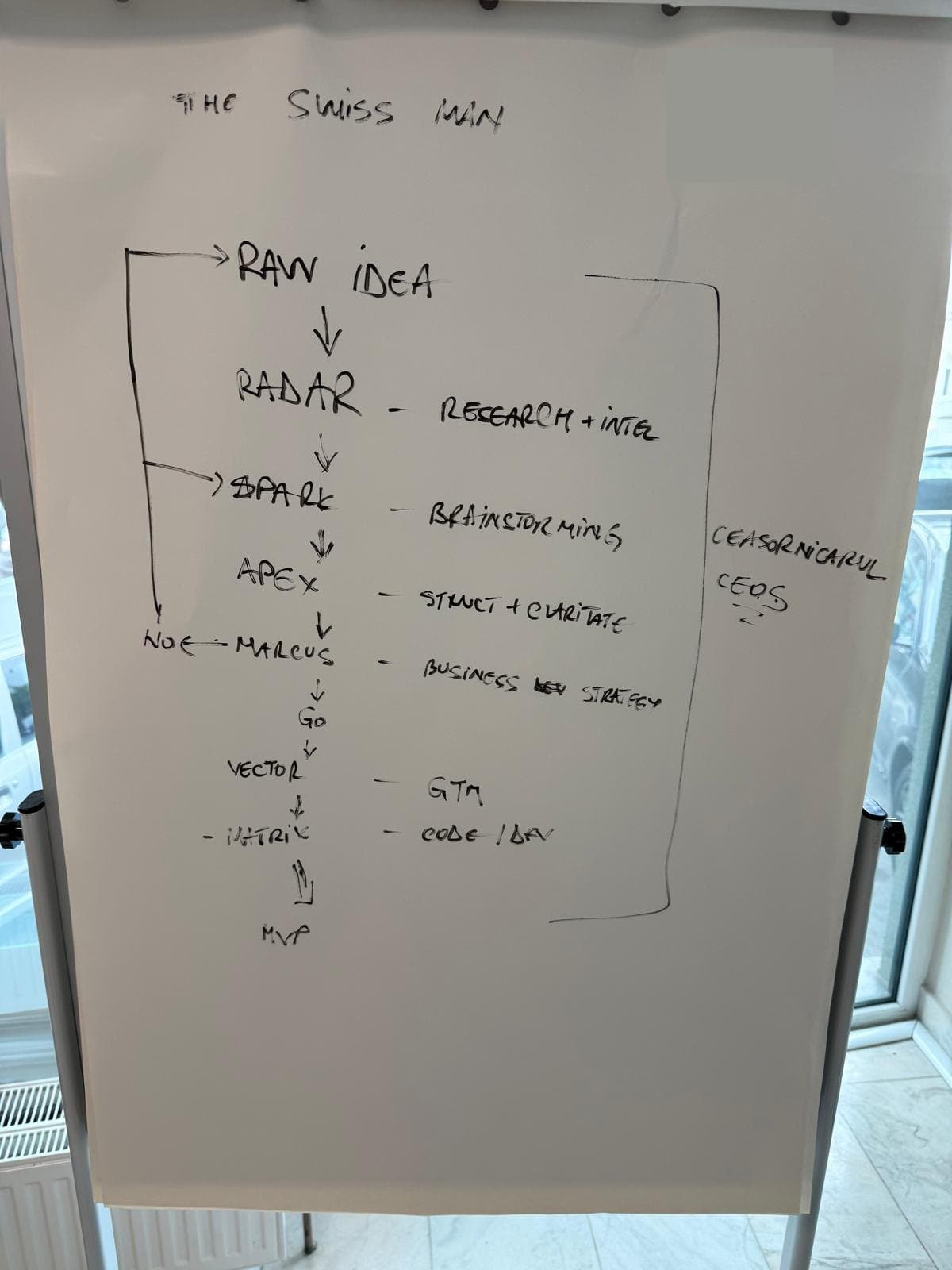
It worked well enough that keeping it to myself felt wrong. So here it is: the same system I use, pointed at your idea.
Andrei · first 10 years at sea, then 10 years CEO, now building
Here’s how the team keeps time:
How CEOS works
16 phases. One report. A few minutes.
Paste a 1-3 sentence idea. CEOS runs a 16-phase pipeline (research with citations, brainstorming, business model, GTM, spec, Reality Check, dealbreakers, comparables) and ships an audit-grade report you can forward to a co-founder or partner.A Reality Check takes about 6 minutes. A clickable prototype is an optional next step.
How it works
- 1
Research
Market size, competitors, gaps, real opportunity.
- 2
Plan
Business model, go-to-market, risks.
- 3
Build
A Reality Check skips the build by design. A clickable prototype is an optional next step.
What you get, every time
One Reality Check. Same structure, same depth, every idea you bring.
Reality Check
Verdict, top 3 risks, validation experiments, recommended next step, 5-8 open questions, archetype lens.
Dealbreakers ranked
Severity × likelihood, mitigation per risk, category-tagged.
Comparables
3-6 prior companies, outcome, why comparable, source URL.
Dynamic caveats
What this Reality Check can't determine, with evidence quotes.
Sources
Every claim cites a real, live-validated URL. No hallucinations.
Audit trail
Every phase, every agent, duration, exportable.
You read the Reality Check. You make the call. CEOS does the work in between.
The system
- 16 phases. Named, ordered, repeatable.
- 7 specialized agents. Each with a dedicated role: research, citations, archetype lens, feasibility, red-team, synthesis, recommendation.
- Same input, same output. Deterministic: run it twice, get the same result.
The pipeline is the product. The agents do the work a good advisor would. The Reality Check is what you walk away with.
CEOS runs 16 phases with 7 specialist agents, then self-corrects its score before the verdict.
See a real one
B2B vertical SaaS for independent veterinary clinics. Verdict: “Worth a closer look.” 16-phase pipeline visible, Reality Check + comparables + sources all populated.
About 6 minutes · first one free, no card